Every leader(or any working professional) faces friction when integrating AI into their workflow—it’s natural inertia. The solution? Start doing. This matrix offers a structured approach: begin with simple, low-risk tasks to build familiarity, then progressively tackle higher-stakes scenarios as confidence grows.
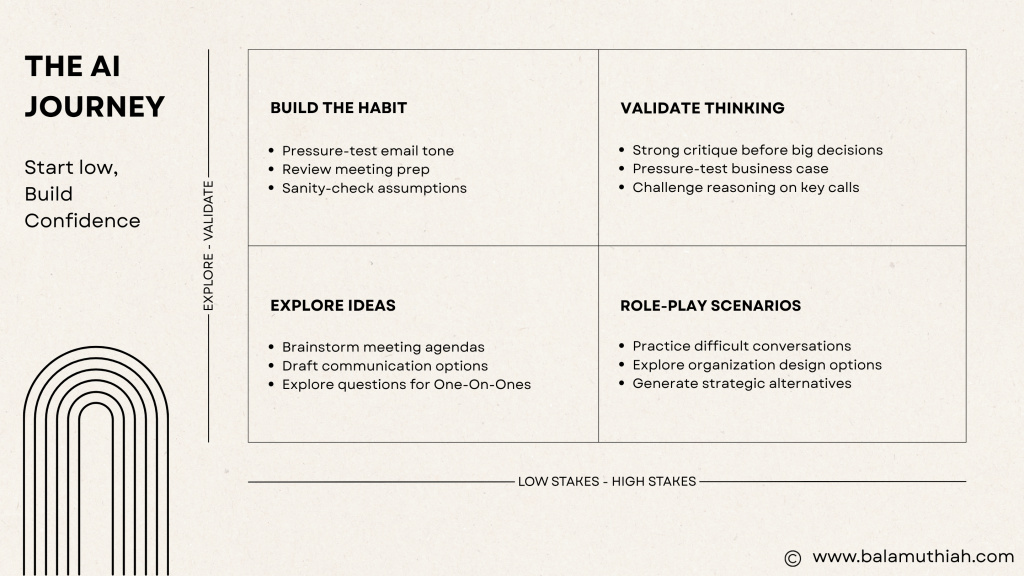
The framework is organized along two dimensions: stakes (low to high) and purpose (explore to validate).
Start with Exploration (bottom-left): Build the habit through low-stakes experimentation—brainstorm meeting agendas, draft communication options, or explore questions for one-on-ones. These activities carry minimal risk while helping you understand AI’s capabilities.
Build the Habit (top-left): As comfort grows, use AI for everyday validation tasks like pressure-testing email tone, reviewing meeting prep, or sanity-checking assumptions. You’re still in low-stakes territory, but now AI becomes a regular thinking partner.
Role-Play Scenarios (bottom-right): When facing higher-stakes decisions, use AI to explore possibilities—practice difficult conversations, examine organization design options, or generate strategic alternatives. The stakes are higher, but you’re still in exploratory mode.
Validate Thinking (top-right): Finally, leverage AI for critical validation—strong critique before big decisions, pressure-testing business cases, and challenging reasoning on key calls. This is where AI adds the most value, but you’ve built the judgment to use it wisely through the earlier stages.
The gap between knowing about AI and using it effectively closes one small experiment at a time.
 Bala Muthiah
Leave a comment